

Padua. A jewel of a city where art feels right at home.
An itinerary that lives up to expectations—including those of the palate.
Padova. Città Gioiello dove l’arte è di casa
Padova is the hidden gem of Veneto. Located between Venice and Verona, near Euganean Hills, it is a particularly lively city and full of surprises. Which houses great artistic and cultural traditions and an important university, it is vibrant with a year-round calendar of events, from cinema to theater, music to art, and sport to folklore. Three thousand years of history showcased through countless wonders, artistic treasures, and unmissable religious destinations makes Padova one of the most interesting places in Veneto, a city that can be discovered on foot, letting yourself be guided by emotions, the desire to know something new, and the city's eye catching landmarks. Gems to uncover by walking, enjoying yourself on a long and soul-stirring walk.
Our tour starts at the grand church of Santa Giustina, right at the edge of the historical town, on its eastern part. Among the largest basilicas of Christianity, It stands as a true marvel of Renaissance architecture that commands attention for its scale; almost one hundred and twenty meters in length and over eighty in height. Serving as the area's earliest sacred site and gazing upon Prato della Valle, it holds the holy relics of Saint Luke and Saint Justina. The facade, which was supposed to be covered in marble, was never completed. The vast and bright interior is divided by large pillars into three aisles. In addition to the basilica, are the small chapel dating back to the 6th century and the martyrs' well. Lastly, the connected Benedictine monastery is also worth a visit, showcasing painted cloisters, a specialized lab for restoring old texts, and an extensive collection of books
The basilica overlooks Prato della Valle, our walking tour’s second key stop and the city's grandest square, ranking among the largest across Europe. The view over the square is truly spectacular, featuring a late-18th-century layout centered around the elliptical Memmia Island. This central island is encircled by a narrow canal, its banks lined with 78 statues, honoring famous figures such as Livy, Torquato Tasso, Pope Eugene IV, Ludovico Ariosto, Francesco Petrarch, and Galileo Galilei
Another essential religious landmark is the basilica, called "il Santo" (the Saint) by locals. Ranking among the world's most revered sanctuaries, the Basilica of Saint Anthony—constructed between 1232 and the mid-1400s is the final resting place of the saint and safeguards his holy relics. A striking fusion of architectural traditions defines this magnificent basilica, blending a Romanesque gabled front with Gothic buttresses and flying buttresses, Byzantine-style domes, and slender bell towers that echo the design of minarets.
Returning to Prato della Valle, we turn into vibrant via Umberto I, rich in prestigious buildings. Among these are the crenellated feudal Palazzo Capodilista, featuring a tall medieval tower and a beautiful Romanesque facade—one of the few 13th-century structures left in the city and a 17th-century internal grand staircase. Here we also find the 15th-century Casa Olzignani, one of the most precious examples of 14th-century Paduan architecture. Andrea Palladio was born right in this area of the city, on via Rogati.
Continuing along via Roma, a vital path connecting the road between the city center and the southern district. Here we find the Church of Santa Maria dei Servi, a single-nave church with a beautiful keel-shaped wooden ceiling and the lavish Baroque altar of the Madonna Addolorata.
For a detour, we turn onto via Canziano to reach Piazza delle Erbe. Historically known as "Della Biada" (Grain Square) and later "Del Vino" (Wine Square) due to the markets held there, it features the 16th-century Palazzo del Podestà, the Neo-Romanesque Palazzo delle Debite, and the Medieval Palazzo della Ragione, which dominates the scene in one of Italy's most picturesque open-air market. Measuring 82 meters long and 27 meters wide, Palazzo della Ragione served as the ancient seat of Padua's city courts. Built starting in 1218, it is one of the largest suspended halls in Italy and one of Europe’s most famous civic monuments from the Age of the Communes.
Just a short walk from Piazza delle Erbe and Piazza della Frutta, which frame Palazzo della Ragione, lies the square at the heart of the city: Piazza dei Signori (or Piazza della Signoria), which served as the stage for celebrations and tournaments for centuries. It is dominated by the famous medieval Clock Tower, which stands between Palazzo dei Camerlenghi and Palazzo del Capitanio—both works in the Mannerist style. The square is surrounded by buildings from various eras and styles, most of which stand over 14th and 15th-century porticoes, some boasting remarkable medieval and Renaissance decorations.
Via Monte di Pietà leads us from Piazza dei Signori to Piazza del Duomo. The Cathedral of Santa Maria Assunta appears on our right, alongside the Bishop's Palace complex, which has been the episcopal seat since the 4th century. The current 16th-century building included contributions by Michelangelo Buonarroti. The Cathedral Baptistery, dedicated to Saint John the Baptist, is unmissable. Inside, it preserves a splendid 14th-century fresco cycle, a masterpiece by the Florentine painter Giusto de' Menabuoi.
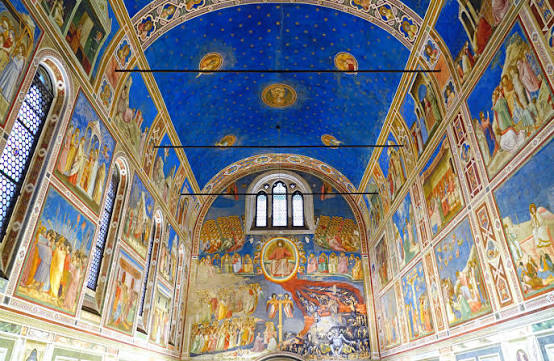
We head back toward Piazza della Frutta and turn onto via VIII Febbraio, to arrive at Scrovegni Chapel. Passing through Piazza Garibaldi, we continue until we reach the green area that hosts the Romanesque chapel. Dedicated to the Virgin Mary Annunciate, it was commissioned between 1303 and 1305 by Enrico Scrovegni, a wealthy Paduan banker, to be frescoed by Giotto of Florence. A masterpiece of 14th-century Italian and European painting, it is the most complete fresco cycle created by the Tuscan master. The artwork completely covers the walls, creating an extraordinary narrative of the stories of the Virgin Mary and Christ. The painting of the Last Judgment on the counter-facade is vast and occupies the upper wall. This is yet another treasure in a city rich in art and history but also traditions, where no matter how much you visit, you can never see enough. There are simply too many palaces, churches, squares, museums, bridges, and architectural details in a city that is vibrant and dynamic by day, and more atmospheric and romantic by night.
The unmissable side of Padua also belongs to its porticoes, a true source of pride for locals. They showcase various styles—from Gothic to Romanesque, and Renaissance to Neoclassical and modern. Underneath them, you can sit in refined restaurants, enjoy the atmosphere of old taverns, or grab a table at one of the historic cafes. Our delicious break is an exciting one: we taste the flavorful Veneto Berico-Euganeo PDO prosciutto, a local Colli Euganei Cabernet Sauvignon wine, and traditional bigoli—the local pasta similar to thick spaghetti, prepared with flour, eggs, water, and salt. We enjoy a sweet finish with the Pan del Santo, an unforgettable finale in the shadow of the Pontifical Basilica of Saint Anthony.
Contact
We are here to answer all your questions and make your stay in Padua unforgettable.
Info & reservations CALL US
